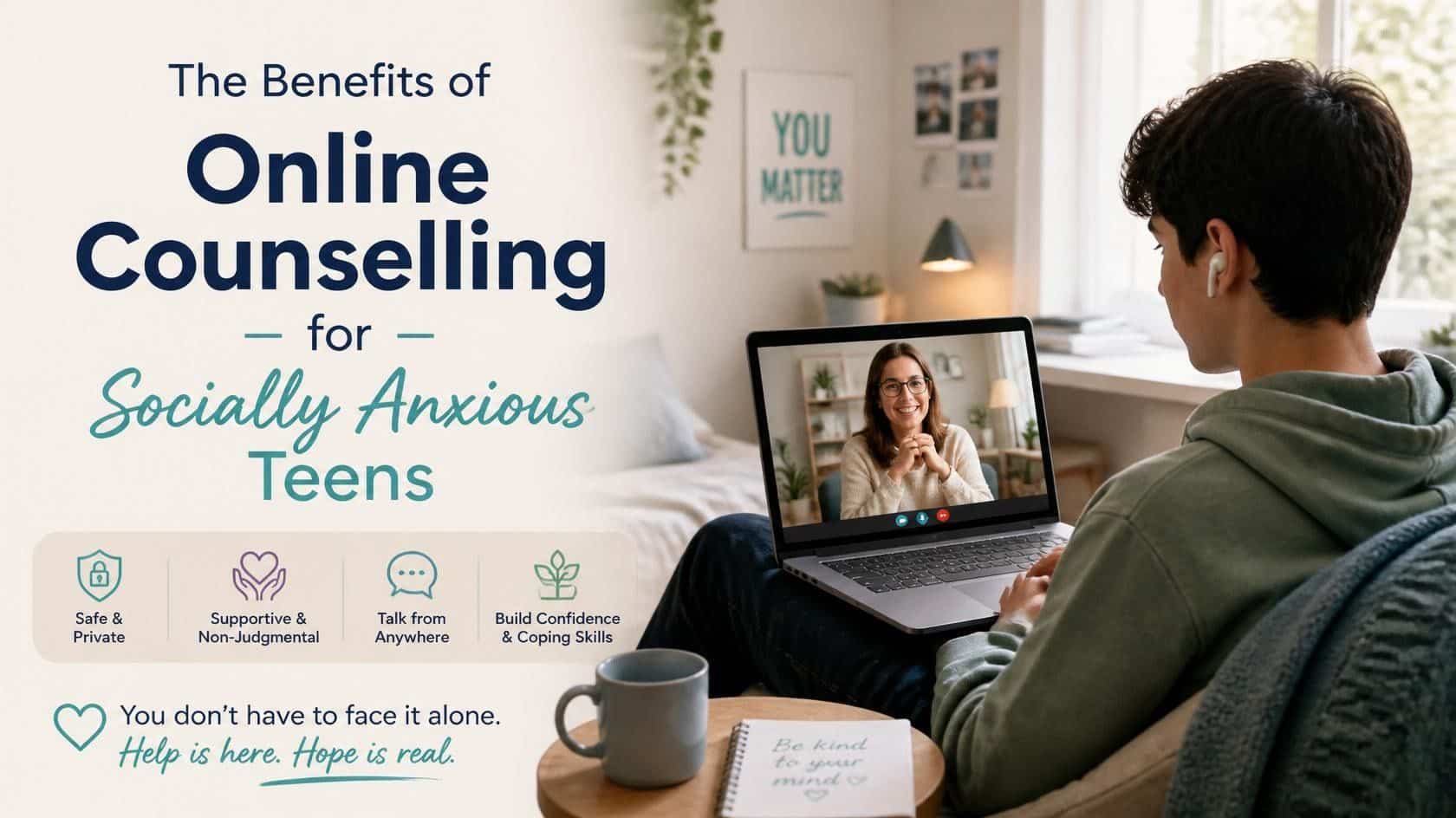
There’s a particular irony in social anxiety and the thing that would help most is talking to someone. This is the very thing that feels most terrifying. For teenagers struggling with social anxiety, the idea of walking into a therapist’s office, sitting in a waiting room full of strangers, and opening up to someone they’ve never met can feel completely overwhelming.
This is one of the reasons online counselling has been such a significant development for young people’s mental health. For socially anxious teenagers especially, the online format removes some of the biggest barriers to getting help and the evidence suggests it’s just as effective as face-to-face therapy for most presentations.
For a socially anxious teenager, the waiting room can feel like a gauntlet. Sitting among strangers, not knowing what to do with their hands, worrying about being seen. All of this can trigger anxiety before the session has even started. Online counselling eliminates this entirely. There’s no travel, no waiting room, no unfamiliar building to navigate. The session starts from wherever they feel safest.
Teenagers tend to open up more easily in familiar environments. Being at home in their own room, in comfortable clothes, with their own things around them, can make it significantly easier to access and articulate emotions that might feel locked away in a clinical setting.
This matters more than it might seem. The quality of what happens in a therapy session depends heavily on how safe and comfortable the young person feels. Anything that reduces that barrier to openness is genuinely therapeutic.
For socially anxious teenagers, even the act of going to therapy can feel exposing. What if someone sees them? What will they say? Online counselling sidesteps the social visibility of attending appointments in person, which, for some young people, is the difference between accessing help and not accessing it at all.
Teenagers have packed schedules with school, homework, extracurriculars, social lives. Online sessions can be arranged around these commitments far more flexibly than in-person appointments, reducing the disruption and the associated anxiety about missing things or being “different.”
Research consistently shows that online therapy delivers comparable outcomes to face-to-face therapy for anxiety, depression and a range of other presentations. CBT in particular translates very well to an online format with the structured, skills-based nature of the work doesn’t require physical presence to be effective.
Sessions take place via a secure video platform unlike a video call, but with full clinical governance and confidentiality protections in place. The therapist and teenager talk, work through exercises, and develop skills together, just as they would in person. Between sessions, teenagers are often given practical tasks to try in their daily life, which can actually be easier to implement when the session has taken place in their home environment.
Online therapy works best when the young person has a private, quiet space for their sessions. Ideally somewhere they won’t be overheard or interrupted. It’s worth thinking about this practically before starting. Some teenagers also prefer to meet their therapist in person for an initial session before moving online, which many providers are happy to accommodate.
Research suggests yes, for most presentations, including anxiety and depression, online therapy produces comparable outcomes to in-person work. The most important factor is the quality of the therapeutic relationship, which can be built just as effectively online.
A device with a camera and microphone (laptop, tablet or phone), a stable internet connection, and a private space where they won’t be overheard. That’s it.
This is worth discussing with the therapist at the outset. Many socially anxious teenagers actually find video calls easier than in-person meetings, but if the camera itself feels too exposing, some therapists can accommodate audio-only sessions initially while trust is built.
Yes, in most cases. It’s worth informing both providers so they can coordinate if needed, but there’s no reason a teenager can’t benefit from both simultaneously.
As therapy providers, we use secure, encrypted platforms specifically designed for clinical use. Not the standard consumer video apps.
If you have any other questions or concerns please do contact us.
CONTACT THE TEAM